A suspected fracture needs more than an X-ray and a cast: the injury must be assessed for circulation, nerve damage, displacement, soft-tissue injury and the risk of later complications. By the end, you will know which warning signs require immediate care, what treatment decisions a specialist makes, and how nearby follow-up can support safer recovery.
Key takeaways
- Treat open fractures, severe deformity, and circulation changes as emergencies.
- Do not move a suspected spinal injury before emergency help arrives.
- Ask how the fracture type affects casting, reduction, surgery, and recovery.
- Attend follow-ups to monitor alignment, healing, movement, and circulation.
Which fracture symptoms need emergency care, and what should you do first?
An open wound over the bone, uncontrolled bleeding, severe deformity, suspected head or spinal injury, or inability to bear weight needs immediate hospital assessment, not a routine appointment. Numbness, blue or cold fingers or toes, or an absent pulse are emergency signs; do not wait for a missing pulse, because it is a late finding.
Before reaching care:
- Keep the limb still in its current position. Never straighten it or push exposed bone back into place.
- Remove rings and watches before swelling increases.
- Cover an open wound with a clean dressing without probing or repeatedly opening it.
- Apply ice wrapped in cloth for 15 to 20 minutes. Do not place ice directly on skin.
- Avoid food or drink when a clinician says surgery may be needed.
| Symptom | Why it matters | What to do |
|---|---|---|
| Open wound or uncontrolled bleeding | Contamination, blood loss and soft-tissue damage can threaten the limb | Apply gentle dressing pressure around, not onto, exposed bone, and seek emergency care |
| Escalating pain, tense swelling or pain when fingers or toes are gently stretched | These can indicate compartment syndrome | Seek immediate surgical assessment |
| New weakness, numbness, pale or blue digits, or cold skin | Nerves or circulation may be compromised | Obtain emergency reassessment, even if a pulse remains |
Prompt assessment matters even without these signs because swelling and circulation problems can develop after the injury. A cast or splint can also become dangerously tight. Searching for an orthopedic doctor near me must not delay emergency care; arrange urgent review for worsening pain, altered sensation or reduced movement.
What happens during fracture assessment in Sus Road?
A fracture assessment begins with the injury mechanism and a documented neurovascular examination, not with a scan alone. The specialist checks the skin and soft tissues, then records colour, temperature, pulses, capillary refill, sensation and movement before any splinting or reduction.
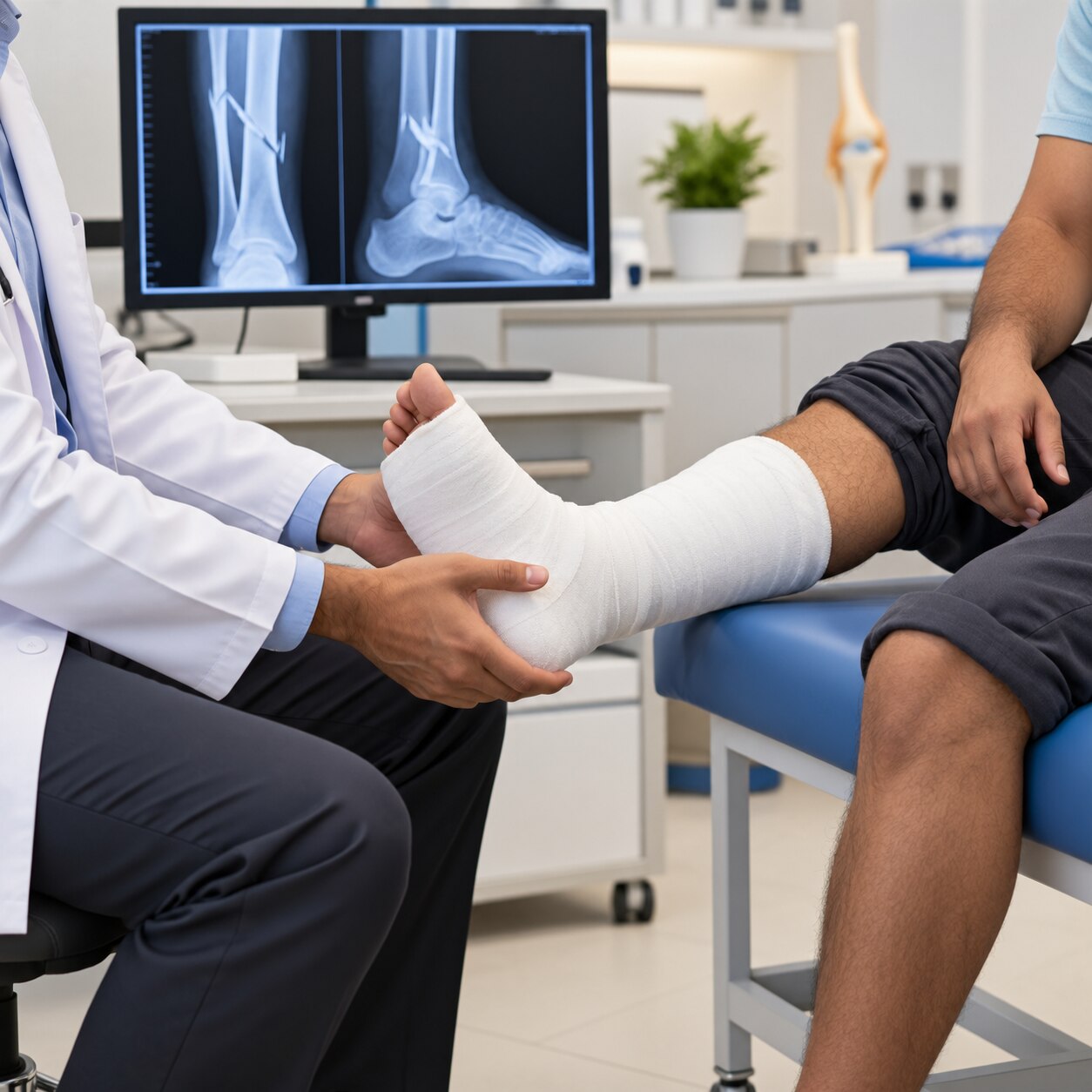
1. Plain X-rays in two views are usually the starting point. A normal first X-ray does not always exclude a fracture, especially with stress injuries or small, hidden breaks. If pain and examination findings keep suspicion high, repeat radiographs or MRI may be advised.
CT is particularly useful for complex joint, pelvic or spinal fractures; MRI can show some occult, stress, marrow and soft-tissue injuries.
2. A displaced fracture needs suitable pain relief or anaesthesia before reduction. The clinician documents circulation, sensation and movement, restores alignment, immobilises the limb in a protective position, repeats the neurovascular examination and obtains post-reduction imaging. Manipulation without these safeguards can worsen nerve, vessel or soft-tissue damage.
3. An open fracture needs urgent specialist management. Cover the wound with a saline-soaked dressing and sterile occlusive layer, give intravenous antibiotics as soon as possible—ideally within one hour—and avoid repeated wound exploration outside an operating theatre. The operation is planned around contamination, blood supply and soft-tissue damage.
This is why fracture care sus road involves more than obtaining a scan: every step protects circulation, alignment and future function. When comparing a bone fracture specialist Sus Road service, check for these documented assessment, imaging, reduction and open-fracture pathways.
How does the fracture type determine the right treatment?
The X-ray pattern—not the word fracture alone—drives treatment. Displacement, angulation, rotation, shortening, joint-surface involvement, bone loss and soft-tissue damage determine whether protection, reduction or surgery is safest.
| Type | What it means | Likely treatment direction |
|---|---|---|
| Closed | No wound communicates with the fracture | A stable injury may need a splint, plaster cast or walking boot |
| Open | The broken bone connects with an open wound, increasing contamination and infection risk | Urgent antibiotics, sterile coverage and specialist surgery planning |
| Displaced | Fragments have shifted or the bone is angulated, shortened or rotated | Closed reduction if alignment can be restored; plates, screws, rods or wires if it cannot be maintained |
| Comminuted | The bone has several fragments | Careful planning; fixation depends on stability, bone loss, joint involvement and soft-tissue condition |
| Stress | Repetitive loading has caused a crack | Load restriction; MRI when X-rays are unrevealing |
| Greenstick | A child’s bone bends and cracks without breaking fully | Specialist assessment and age-appropriate immobilisation |
| Growth-plate | The injury involves the area guiding bone growth | Prompt specialist review because alignment can affect continuing growth |
A swollen limb often needs a temporary splint before a full cast. Traction has a limited role when controlled pulling is needed to maintain length or alignment. Internal fixation becomes a consideration when the fracture is unstable, involves a joint surface, or vascular and soft-tissue concerns demand controlled repair.
- Do not manipulate a displaced fracture yourself. Safe reduction requires pain relief or anaesthesia, imaging, neurovascular checks, immobilisation and post-reduction imaging.
- When comparing a bone fracture specialist sus road, ask how the imaging pattern, swelling and function—not proximity alone—will determine the plan.
What should follow-up monitor after a fracture is treated?
Follow-up checks are what confirm that the fracture is staying aligned, healing, and not causing a new circulation or wound problem. A cast, splint or operation starts treatment; it does not finish it. Reviews assess:
- Swelling, skin condition, circulation, sensation, movement and pain
- Alignment and progressive bone union
- Wound healing and the condition of the cast, splint or surgical site
- Whether rehabilitation and load restrictions remain appropriate
Seek prompt clinical review if a cast becomes increasingly painful, tight, wet, cracked or foul-smelling. Numbness, tingling, cold or discoloured fingers or toes, or inability to move them, also needs urgent assessment. Do not cut, loosen or pad the cast yourself; these changes can signal swelling, pressure or a circulation problem.
Repeat X-rays or other imaging are used when the treating clinician needs to confirm maintained alignment and progressive healing. Early joint movement does not mean unrestricted weight-bearing: a physiotherapist may prescribe movement of nearby joints while keeping weight off the injured bone.
Persistent tenderness, increasing deformity, worsening function or absent progress on imaging can indicate delayed union or nonunion. Smoking, poor blood supply, infection and severe soft-tissue damage increase this risk.
After a low-energy fracture, an older adult should discuss osteoporosis assessment, fall prevention, vitamin D and calcium adequacy, and bone-strengthening treatment when indicated. Your treating doctor sets the review schedule; online timelines cannot replace it.
What are the practical benefits of choosing fracture care near Sus Road?
Choosing fracture care near Sus Road can reduce painful travel and speed up decisions without making distance a substitute for clinical quality. Faster access supports timely neurovascular examination, imaging and treatment when swelling, numbness or deformity is changing.
A coordinated local service can also prevent repeated journeys for X-rays or CT, reduction, casting, wound reviews and rehabilitation. Keeping the same clinical team involved makes it easier to track alignment, wound healing and recovery.
| What to check | Practical benefit | Question to ask |
|---|---|---|
| Neurovascular assessment | Detects circulation or nerve problems before and after splinting or reduction | Will you document colour, temperature, pulses, capillary refill, sensation and movement? |
| Imaging pathway | Matches two-view X-rays or advanced imaging to the suspected injury | Can you arrange CT when the fracture is complex or the joint is involved? |
| Treatment and follow-up | Limits delays between reduction, fixation, cast checks and rehabilitation | Can you manage or safely refer open fractures and provide planned reviews? |
Local follow-up makes prompt reassessment easier when a cast becomes tight, swelling changes, a wound needs review, or pain and sensation worsen. An orthopedic clinic near me or an orthopedic doctor near me should therefore be judged by these capabilities, not distance or online ratings alone.
For fracture care sus road, Latkar Multi-speciality Clinic can be considered when you want orthopaedic assessment, fracture treatment and coordinated follow-up in the area. Open fractures, absent pulses, blue or cold digits, severe deformity or suspected compartment syndrome require the nearest appropriate hospital or emergency service.
Related products
 | Tramatology and Fractures surgeon in pune Tramatology and Fractures A bone fracture is a medical condition in which a bone is cracked or broken. It is a break in the continuity of the bone. View product → |
 | Bone Fractures & Joint Dislocation DISLOCATION Bone Fractures & Joint Dislocation Two of the most common bone and joint injuries are fractures and dislocations. |
Frequently asked questions
Which fracture symptoms need emergency care?
Seek immediate hospital assessment for an open wound over the bone, uncontrolled bleeding, severe deformity, suspected head or spinal injury, or inability to bear weight. Numbness, blue or cold fingers or toes, and an absent pulse also require emergency care.
What should you do first when a fracture is suspected?
Keep the injured area still, control bleeding with a clean dressing without pushing exposed bone back inside, remove rings or tight items, and seek emergency medical help. Do not move someone with a suspected spinal injury unless danger makes movement necessary.
What happens during fracture assessment in Sus Road?
The clinician checks the injury, skin, swelling, sensation, movement, and blood flow, then uses imaging such as an X-ray when needed. The assessment also records how the injury happened and checks for nearby joint, nerve, or blood-vessel damage.
How does the fracture type determine treatment?
Treatment depends on factors such as whether the fracture is closed or open, displaced or stable, joint-involving, and associated with nerve or blood-vessel damage. Options include immobilisation, reduction, surgery, pain control, and rehabilitation.
What should follow-up monitor after fracture treatment?
Follow-up checks whether the bones remain aligned and are healing, while also monitoring pain, swelling, skin condition, movement, sensation, and circulation. Attend earlier if pain worsens, numbness develops, fingers or toes change colour, or a cast becomes too tight.
Keywords