New bladder or bowel problems, saddle numbness, paralysis, or rapidly worsening leg weakness require emergency hospital assessment rather than a routine clinic appointment. You will learn how to judge the urgency, arrange safe transport, compare surgeons and facilities, verify qualifications, and ask informed questions before urgent spine surgery.
Key takeaways
- Seek emergency assessment for bladder, bowel, saddle sensation, or rapidly worsening leg changes.
- Do not drive if weakness, severe pain, or loss of control affects your safety.
- Bring medication details, scans, reports, allergies, and symptom timing to the hospital.
- Verify the diagnosis, proposed procedure, risks, alternatives, and surgeon’s hospital privileges.
Which spine symptoms require emergency assessment now?
New urinary retention, urinary incontinence, loss of bowel control, saddle numbness, or rapidly worsening leg weakness requires emergency hospital assessment now. These signs can indicate cauda equina compression, where delayed treatment can cause permanent bladder, bowel, or leg problems.
Paralysis, fever with severe back pain, or severe neurological symptoms after a fall or road crash also demand urgent care.
Searching for the best spine surgeon near wakad should not delay transfer to a hospital with urgent MRI and spine-surgery capability.
| Situation | What it may indicate | Correct response |
|---|---|---|
| New bladder retention or incontinence, bowel-control loss, saddle numbness, or rapidly worsening weakness | Possible cauda equina compression | Go to the emergency department immediately |
| Paralysis, inability to stand, or new weakness after a fall or road crash | Possible spinal cord injury or unstable fracture | Keep the spine supported and request emergency transport |
| Fever with severe back pain, especially with weakness or confusion | Possible spinal infection or another serious illness | Seek immediate hospital assessment |
| Severe back pain without weakness, numbness, bladder change, fever, or major injury | Often suitable for clinical evaluation rather than emergency surgery | Arrange same-day or scheduled assessment based on pain severity |
Before transport:
- Do not drive if your legs are weak, numb, or painful, or if you cannot stand safely.
- Keep your back and neck supported; do not forcefully stretch, twist, or manipulate the spine.
- Take previous scans, discharge papers, a medication list, and details of blood thinners.
- Tell emergency staff exactly when weakness, numbness, bladder, or bowel changes began.
What should you do before reaching emergency spine care?
Severe pain with new weakness, numbness, inability to stand, or bladder or bowel changes needs hospital assessment now, not a search for an orthopedic clinic near me. Arrange emergency transport immediately, especially after a fall or road crash. Do not wait for pain medicine to work or for a routine appointment.
1. Do not drive yourself. Leg weakness, numbness, severe pain, or reduced balance can make driving unsafe. Ask someone to call emergency services and describe the symptoms, their onset, and any injury.
2. Keep your back and neck supported in the position that hurts least. After trauma, avoid unnecessary movement until trained help arrives. Do not forcefully stretch, twist, massage, or allow spinal manipulation; these actions can worsen nerve or spinal-cord injury.
3. Send prior MRI, CT, or X-ray reports with you, along with the actual images if available. Carry a written medication list, allergies, major illnesses, blood-thinning medicines, and the time symptoms began.
A same-day assessment fits severe but stable pain without weakness, numbness, walking difficulty, bladder or bowel change, fever, or recent trauma. A scheduled consultation is reasonable when symptoms remain stable, you can walk safely, and no warning sign develops. Worsening symptoms change that decision: go to emergency care immediately.
How will a spine specialist doctor assess the problem?
A spine specialist doctor first decides whether nerve or spinal cord function is deteriorating. An orthopaedic spine surgeon or neurosurgeon will compare your symptoms with a focused neurological examination, not judge the scan alone.
- Test leg and arm strength for weakness.
- Map sensation for numbness or altered touch.
- Check reflexes for signs of nerve-root or spinal-cord involvement.
- Watch you stand and walk to assess gait, balance and coordination.
- Ask about urinary retention, incontinence, bowel control and saddle numbness.
- Record the injury mechanism, including a fall, road crash or twisting load.
Tell the doctor if you have fever, a current or previous cancer diagnosis, or take blood-thinning medication such as warfarin, apixaban, rivaroxaban or clopidogrel. These details change the urgency, bleeding assessment and possible treatment. Severe neurological loss after trauma requires immobilisation and hospital imaging rather than walking into a routine appointment.
The scan is selected for the question the examination raises:
| Test | What it shows best | When it is selected |
|---|---|---|
| MRI | Nerve compression, spinal cord injury and soft-tissue disease | Weakness, sensory loss, cauda equina symptoms, suspected infection or tumour |
| CT | Bone detail and fractures | High-impact injury, complex fracture or when MRI is unavailable |
| X-ray | Alignment, vertebral height and movement-related instability | Suspected fracture, deformity or instability; it cannot rule out nerve compression |
A disc bulge matters only when its level and side match the examination and symptoms.
How should you compare a spine surgeon and hospital near Wakad?
Compare the surgeon and hospital by documented capability, not by search position, testimonials, or the phrase best spine surgeon in pune india. An orthopaedic spine surgeon and a neurosurgeon can both be appropriate; the decisive evidence is training and experience with your diagnosis and proposed operation.
| Capability | What to verify | Why it matters |
|---|---|---|
| Registration | Search the doctor’s name in the National Medical Commission’s Indian Medical Register | Confirms lawful registration, not spine expertise |
| Spine training | Fellowship, advanced spine training, or equivalent documented qualification | Shows focused preparation beyond a specialty label |
| Relevant experience | Experience with your condition and exact procedure, such as fracture stabilisation or decompression | Familiarity with the operation affects planning and complication response |
| Emergency hospital support | Immediate MRI, anaesthesia, intensive care, blood bank, and surgical availability | Prevents a dangerous transfer when weakness or bladder symptoms are progressing |
| Aftercare and escalation | Infection-control practices, rehabilitation, follow-up, and a written transfer pathway | Covers wound problems, neurological deterioration, and services the hospital cannot provide |
An orthopedic doctor near me may offer faster access but still require transfer if the facility lacks emergency MRI or round-the-clock support. Ask who accepts the patient, which hospital receives transfers, how long transport takes, and whether the surgeon continues care after transfer.
Assess Latkar Multi-speciality Clinic by the same evidence: the available team, imaging and operating support, emergency cover, rehabilitation arrangements, and transfer plan. Judge proximity against urgency; for possible cauda equina compression or rapidly worsening weakness, a capable hospital matters more than a higher online ranking.
Related product
 | Best Spine surgeon in pune Spine Surgery By Dr Rajendra Latkar Non Invasive treatment for backache. Root blocks, Fascet blocks for Neuralgias(Nerve Pains). Physiotherapy & Rehabilitation. View product → |
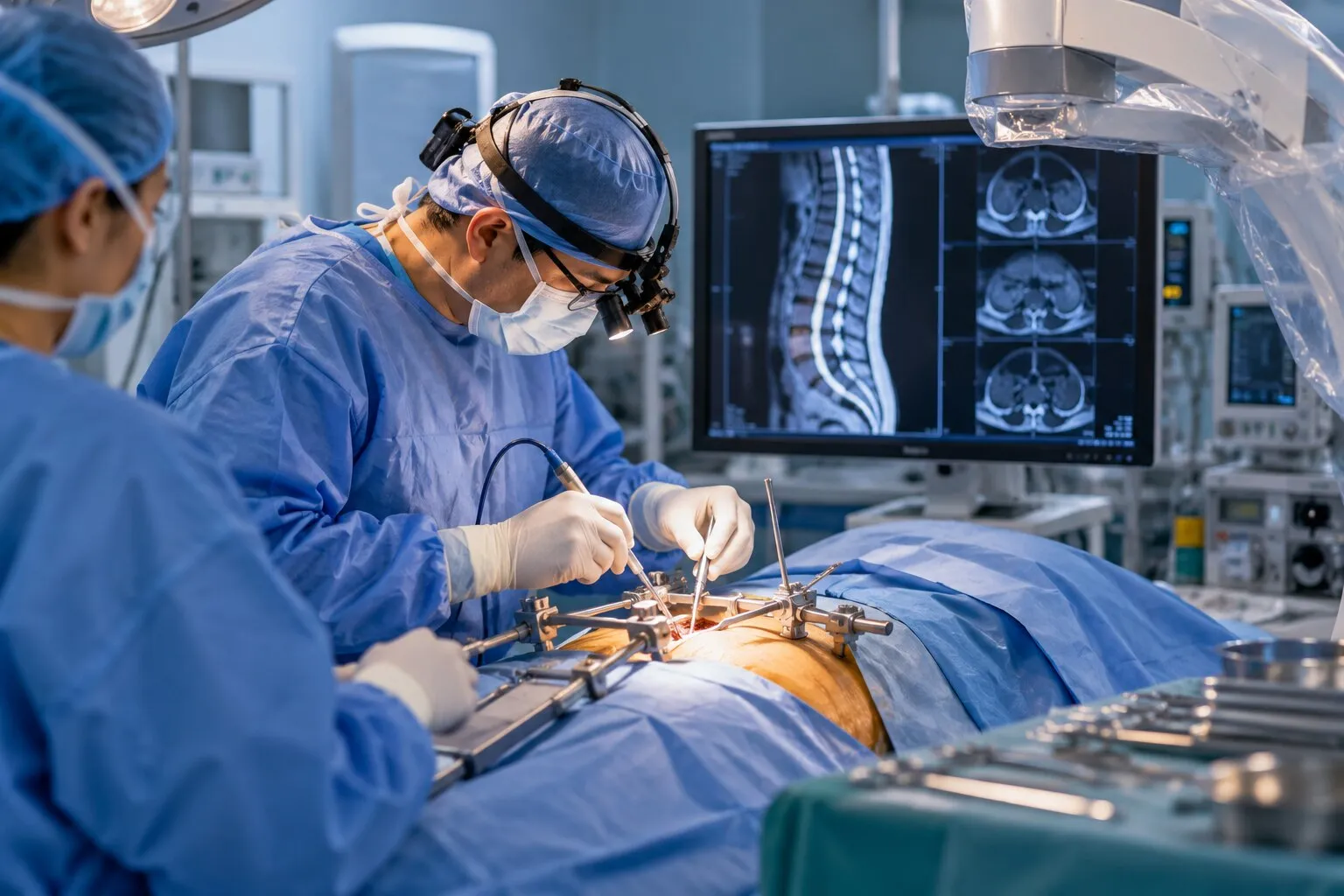
What should you verify before consenting to urgent spine surgery?
Ask the surgeon to answer these questions plainly before you consent. If paralysis, rapidly worsening weakness, urinary retention, bowel loss or saddle numbness is progressing, do not delay urgent treatment for a second opinion.
1. What is the suspected diagnosis, and which spinal level is affected? Ask the surgeon to match the examination and MRI findings to a named nerve, spinal cord problem, fracture or instability.
2. What neurological harm could occur if we wait 24 hours, longer, or choose non-operative care? Ask what symptoms mean you must return immediately.
3. What operation is proposed, at which level, and what is its purpose? Ask about decompression, discectomy or fusion separately, rather than accepting “spine surgery” as an explanation.
4. What alternatives exist, including medicines, injections, physiotherapy, observation or transfer? Ask what could happen if surgery is delayed and whether a second opinion is safe.
5. What benefit is realistic, and which symptoms might not recover? Ask about infection, bleeding, nerve injury, paralysis, dural tear, blood clots, anaesthetic complications, repeat surgery and death.
6. What restrictions, rehabilitation, work absence and follow-up will recovery involve? Ask who handles new weakness, fever, wound drainage or uncontrolled pain after discharge.
A disc bulge alone does not prove that surgery is needed. For sciatica, decompression is considered when non-surgical treatment has not improved pain or function and the scan matches the clinical nerve findings. Fusion needs a specific structural indication; it should not be offered solely for nonspecific low-back pain.
To check a spine specialist doctor, search the National Medical Commission’s Indian Medical Register using the doctor’s name and registration details. Registration confirms identity and licence, not expertise, surgical volume or hospital capability. Verify those separately before choosing the best spine surgeon near Wakad.
Frequently asked questions
Which spine symptoms require emergency assessment now?
New urinary retention, urinary incontinence, loss of bowel control, saddle numbness, or rapidly worsening leg weakness require immediate hospital assessment because they can indicate cauda equina compression.
What should you do before reaching emergency spine care?
Arrange urgent transport, avoid driving when symptoms impair safety, record when symptoms began, and bring scans, reports, medication details, and allergy information.
How will a spine specialist doctor assess the problem?
The specialist will review symptom timing, pain, sensation, strength, reflexes, bladder and bowel function, and imaging such as an urgent MRI when indicated.
How should you compare a spine surgeon and hospital near Wakad?
Compare emergency availability, MRI access, intensive-care support, operating facilities, rehabilitation services, surgeon experience with the proposed procedure, and clear communication.
What should you verify before consenting to urgent spine surgery?
Confirm the diagnosis, procedure name, purpose, urgency, expected benefits, major risks, alternatives, anaesthesia plan, recovery needs, and who will provide postoperative care.
Keywords