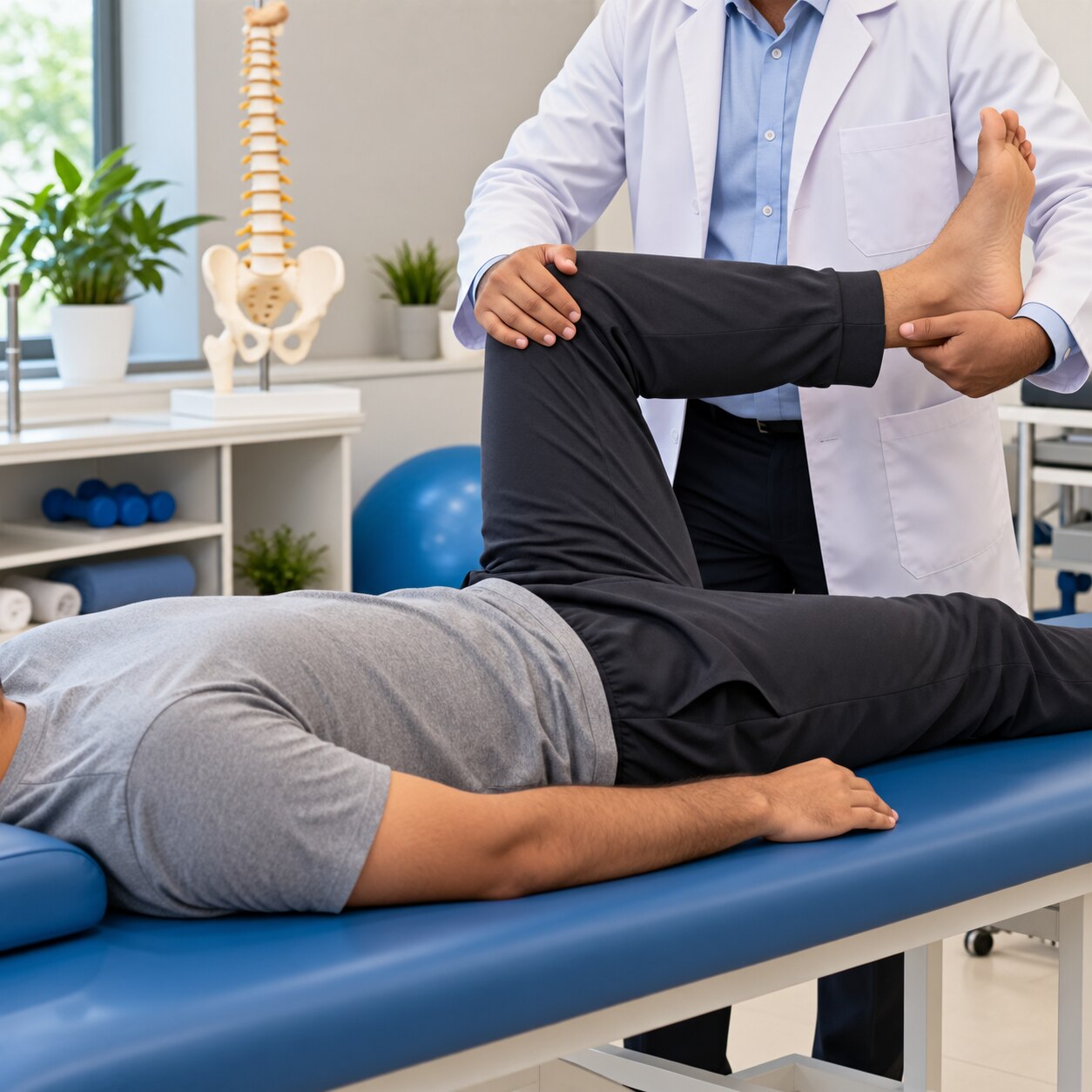
Pain that travels from the lower back or buttock into the leg is not the same as ordinary backache, and the correct treatment depends on the nerve findings, duration and cause. By the end, you will know which symptoms need emergency care, when home-based treatment is reasonable, when an MRI helps, and how to compare a spine specialist doctor in Pune.
Key takeaways
- Emergency care is needed for bladder, bowel or saddle-area numbness.
- Book an appointment for persistent pain, numbness or leg weakness.
- MRI helps confirm nerve compression when symptoms require specialist assessment.
- Treatment usually starts with activity changes, medicines and physiotherapy before surgery.
Is your leg pain sciatica or another condition?
Sciatica is a symptom pattern, not a synonym for back pain. Irritation or compression of a lumbar nerve root causes pain, tingling, numbness or weakness that travels from the lower back or buttock into the leg, often along the sciatic nerve.
The location, sensory changes, weakness and movements that worsen symptoms matter more than the label you use.
| Pattern | Where you feel it | Clues that help distinguish it |
|---|---|---|
| Sciatica | Buttock and down the back or side of the leg, sometimes into the foot | Pins and needles, reduced sensation, weakness, or worsening with coughing, sneezing or bending |
| Muscular back pain | A local area of the lower back | Pain changes with muscle use or movement and usually does not travel below the buttock |
| Hip-joint pain | Groin or front of the thigh | Pain with hip rotation, walking or putting weight on the leg |
| Sacroiliac-joint pain | One side of the lower back or buttock | Usually remains near that area rather than following a nerve into the foot |
A “slip disc” usually means a lumbar disc herniation, but herniated discs are not the only cause of sciatica. Spinal stenosis, spondylolisthesis and peripheral nerve disorders can produce similar symptoms; hip arthritis can mimic leg pain without involving a nerve.
Searching for slip disc treatment before confirming the cause risks treating the scan instead of the condition. A clinical examination can separate these patterns.
When should you treat sciatica at home, book an appointment or seek emergency care?
For uncomplicated sciatica without weakness or warning signs, start with gentle self-care. Keep normal activity as tolerated, take short walks, avoid heavy lifting and prolonged sitting, and use heat or ice with a cloth between it and your skin.
Ask a pharmacist or clinician which pain relief is safe for you, particularly if you have stomach ulcers, kidney disease, high blood pressure, heart disease, take blood thinners, or are pregnant. Avoid prolonged bed rest; inactivity can increase stiffness and delay recovery.
Book a clinical appointment if the pain limits walking, sleep or work; does not clearly improve over several weeks; or causes new numbness or weakness.
Seek emergency assessment rather than waiting for a routine appointment if you have:
- New difficulty passing urine, urinary retention or loss of bladder control
- Loss of bowel control
- Numbness around the genitals, anus or inner thighs
- Severe or worsening weakness, especially weakness in both legs
- Sciatica after major trauma, such as a road crash or fall from height
These symptoms can signal cauda equina syndrome, a fracture or another serious cause. Most uncomplicated sciatica improves without surgery over several weeks to a few months, but deterioration at any point warrants review. Do not wait for a scheduled appointment if weakness, bladder or bowel changes, or saddle numbness appears.
What will an examination and MRI add to the diagnosis?
Before recommending imaging or a procedure, a clinician should document a neurological examination. This includes strength at the hip, knee and ankle; knee and ankle reflexes; sensation in defined areas such as the outer calf, top of the foot and sole; straight-leg raise; heel-and-toe walking; gait; and the pattern, side and triggers of pain.
These findings help identify the affected nerve level.
MRI is useful when serious disease is suspected, objective neurological changes are present, symptoms persist despite suitable non-operative care, or the result would change an injection or surgical decision. Routine scanning of uncomplicated sciatica can reveal age-related abnormalities and encourage treatment aimed at the image rather than the nerve.
| Disc term | What the report means |
|---|---|
| Bulge | The disc extends beyond its normal margin around part of its circumference |
| Protrusion | The outward portion has a narrower span than its base at the disc |
| Extrusion | The disc extends farther through a narrower opening |
| Sequestration | A disc fragment has separated from the main disc |
The MRI must match the painful side, affected nerve level, weakness, sensory loss and reflex change. An abnormal scan alone does not prove that surgery is needed. When discussing slip disc treatment, ask which examination finding the scan explains, what improvement to expect, and which non-operative option comes first.
Which treatments should come first, and when is surgery considered?
Begin with continued activity as tolerated, a structured exercise-based rehabilitation programme and short-term pain relief. Avoid prolonged bed rest; gentle walking usually supports recovery, while heavy lifting or prolonged sitting can aggravate symptoms.
| Option | Place in treatment sequence | Main trade-off |
|---|---|---|
| Exercise-based rehabilitation | Usually first | Builds function, but improvement takes time |
| Manual therapy or massage | Add only alongside exercise | May ease symptoms, but is not a stand-alone cure |
| Epidural steroid injection | Selected acute, severe sciatica | Benefit is usually small and short-term; discuss infection, bleeding and rare neurological complications |
| Discectomy | Consider after failed non-surgical care with matching MRI findings | Can provide faster relief for selected disc herniation, but recurrence or persistent back pain remains possible |
NSAIDs can suit some patients, but use the lowest effective dose for the shortest practical period. A clinician or pharmacist must review stomach-ulcer or bleeding risk, kidney function, blood pressure and cardiovascular disease before use. Do not self-start pregabalin, gabapentin, oral corticosteroids or benzodiazepines: recommended evidence shows no overall sciatica benefit and identifies harm.
Surgery is not routine slip disc treatment. Seek surgical assessment when pain or function remains poor after appropriate non-surgical care and MRI-confirmed nerve compression matches the examination. Many patients recover without surgery.
Get urgent assessment for progressive weakness, new urinary retention or incontinence, loss of bowel control, or numbness around the genitals or anus. These features can indicate cauda equina syndrome and should not wait for routine treatment.
How should you compare sciatica pain treatment in Pune in Maharashtra?
For sciatica pain treatment in Pune in Maharashtra, compare the clinic’s decision-making, not its advertised procedure. Ask whether the clinician records leg strength, reflexes, sensation, gait and straight-leg raise findings before interpreting an MRI.
| Provider check | What good practice looks like | Why it matters |
|---|---|---|
| Neurological examination | Findings are documented and compared with the scan | A scan alone cannot identify the symptomatic nerve |
| Treatment discussion | Activity, exercise, rehabilitation and medication choices are explained | You can weigh non-operative care before procedures |
| NSAID review | Stomach, kidney, blood-pressure and cardiovascular risks are checked | The wrong painkiller can cause avoidable harm |
| Lumbar MRI | Ordered when serious disease is suspected, symptoms persist, or the result could change injection or surgery | Routine imaging can expose harmless disc changes |
| Rehabilitation | Supervised exercise-based rehabilitation is available | Passive treatment alone rarely restores strength and function |
| Diagnosis | Hip, sacroiliac-joint and nerve causes are considered | Similar pain sources need different treatment |
| Escalation | Weakness or bladder and bowel symptoms trigger urgent assessment | Delay can worsen a serious nerve compression |
A spine specialist doctor may be an orthopaedic spine surgeon, neurosurgeon or non-surgical spine physician. The title matters less than examination skill, differential diagnosis and willingness to avoid unnecessary procedures. Latkar Multi-speciality Clinic can be compared with other Pune providers on these practical capabilities, including coordinated assessment, rehabilitation and appropriate referral.
Ask at the visit:
- What nerve is affected?
- What improvement should occur, and by when?
- What finding would make MRI or surgery necessary?
Related product
 | Best Spine surgeon in pune Spine Surgery By Dr Rajendra Latkar Non Invasive treatment for backache. Root blocks, Fascet blocks for Neuralgias(Nerve Pains). Physiotherapy & Rehabilitation. View product → |
Frequently asked questions
Is my leg pain sciatica or another condition?
Sciatica usually travels from the lower back or buttock into one leg and may include tingling, numbness or weakness. Hip disease, sacroiliac joint pain, peripheral nerve problems and circulation disorders can cause similar symptoms, so an examination is needed when the pattern is unclear.
When should I treat sciatica at home, book an appointment or seek emergency care?
Use gentle activity, avoid prolonged bed rest and monitor mild symptoms without progressive weakness. Book an appointment when pain persists, limits walking or sleep, or causes numbness or weakness. Seek emergency care for new loss of bladder or bowel control, numbness around the genitals or anus, or rapidly worsening weakness in both legs.
What will an examination and MRI add to the diagnosis?
A clinician checks walking, posture, spinal movement, reflexes, sensation and muscle strength to identify the affected nerve root and exclude other causes. MRI can show a slipped disc, spinal stenosis or other compression, but it is most useful when symptoms are severe, progressive, persistent or being assessed for an injection or operation.
Which sciatica treatments should come first, and when is surgery considered?
Initial care often combines continued safe movement, prescribed pain relief, physiotherapy and changes that reduce aggravating loads. A specialist may discuss an injection when pain remains disabling. Surgery is considered when nerve compression causes progressive weakness, persistent disabling symptoms despite non-surgical care, or an emergency condition such as cauda equina syndrome.
How should I compare sciatica pain treatment in Pune in Maharashtra?
Compare the clinician’s spine experience, examination process, explanation of MRI findings, non-surgical options, physiotherapy access, emergency arrangements and follow-up plan. Ask what condition is being treated, why each option is recommended and when you should return urgently.
Keywords