
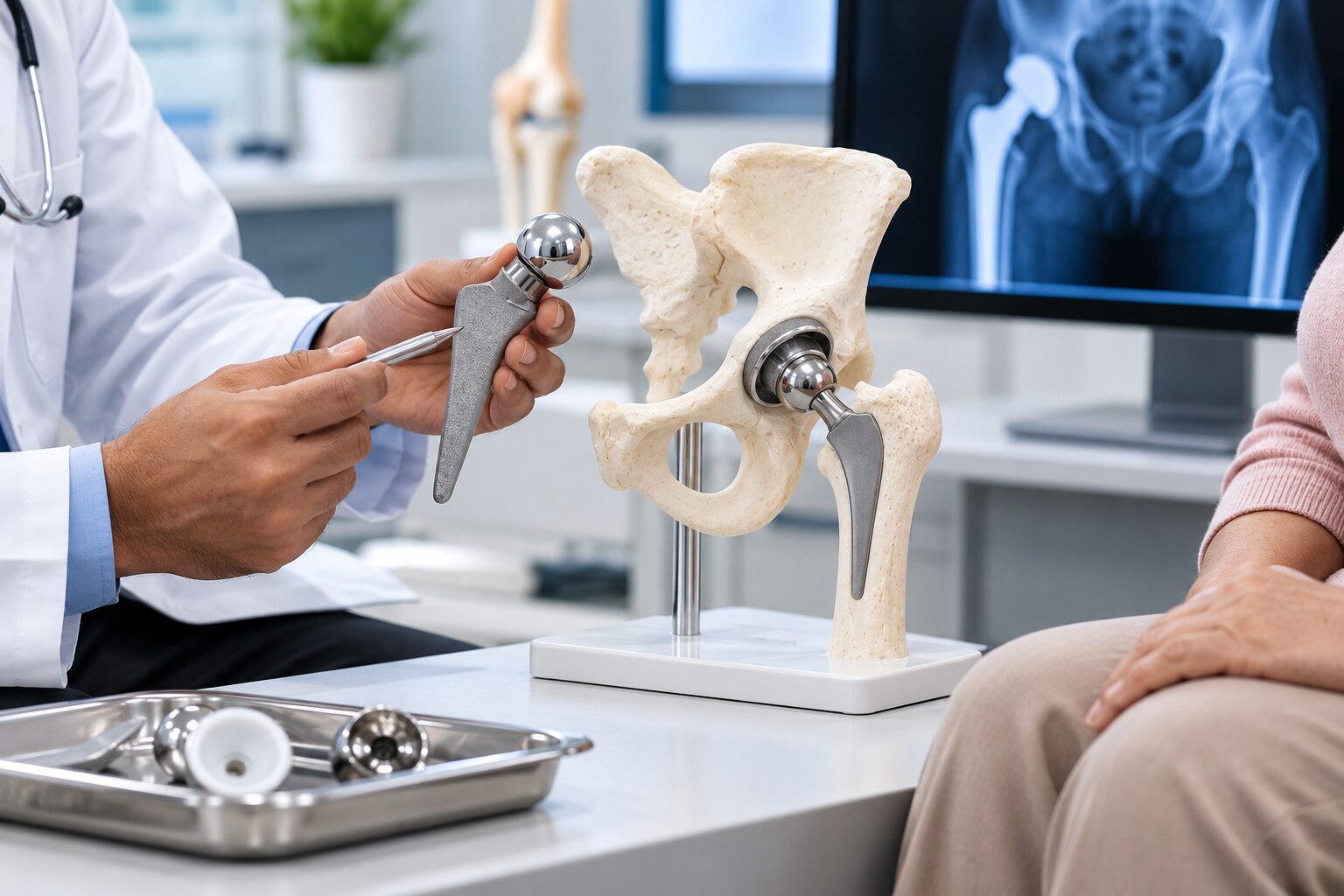
Start by deciding whether you need emergency fracture care or a planned arthritis consultation, then search named surgeons rather than relying on a hospital’s generic orthopaedic department. By the end, you will have a shortlist, a verification checklist, a faster booking process and the questions needed to compare two or three surgeons safely.
Key takeaways
- Seek emergency assessment after a fall with severe pain or inability to bear weight.
- Check Pune hospital websites and Maharashtra Medical Council registration records.
- Book the earliest consultation with enough time for meaningful questions.
- Compare surgical experience, implant choices, risks and recovery plans before deciding.
First decide whether you need emergency care or a planned appointment
A shortened, outward-turned leg, severe groin or hip pain after a fall, or inability to stand or bear weight needs emergency assessment, not a routine clinic booking. A suspected hip fracture requires hospital evaluation; NICE recommends surgery on the day of admission or the following day when medical condition allows.
| Situation | What it suggests | Your next step |
|---|---|---|
| Sudden pain after a fall, inability to bear weight, or a shortened, outward-turned leg | Possible hip fracture or serious injury | Go to an emergency department and let the hospital arrange imaging and orthopaedic review |
| Gradually worsening pain, stiffness and reduced walking despite treatment | Elective arthritis or another planned hip condition | Book a consultation with a hip surgery doctor in Pune and bring your records |
For a planned search, do not choose a hip replacement doctor in Pune solely because an X-ray shows arthritis or because of your age. Surgery becomes a reasonable discussion when pain and loss of function remain substantial despite appropriate non-surgical treatment, and your symptoms match the scans.
To find a hip replacement surgeon in Pune quickly, ask for the earliest assessment slot, cancellation openings and whether the surgeon can review your records before the visit. Take X-rays or scan discs, reports, medication and allergy lists, injection or physiotherapy records, and details of diabetes, heart, kidney or previous surgical problems.
Use Pune location searches, hospital websites and registration records
Start with Google Maps or a hospital website and search “hip replacement specialist near me” or “hip replacement doctor in Pune”, then narrow the results to Aundh and nearby areas you can reach. Hospital orthopaedic or joint-replacement pages are more useful than generic clinic listings because they show where consultations and operations occur.
Ask the booking desk for the earliest assessment slot, cancellation openings, record-upload options and whether preoperative tests can be coordinated at that hospital.
- Check the doctor’s name in the National Medical Commission’s Indian Medical Register and confirm Maharashtra Medical Council registration. These records establish a licence to practise, not hip-replacement expertise.
- Confirm the doctor’s orthopaedic qualification, joint-replacement fellowship or equivalent training, current hospital affiliation and present consulting location.
- Ask, “Will you personally perform my hip replacement?” A clinic referral service, hospital department or general orthopaedic doctor may not be the operating surgeon.
- Verify that the surgeon currently operates at a named hospital with anaesthesia, blood-transfusion, intensive-care and rehabilitation services.
- Request an assessment of your diagnosis, non-operative options, implant fixation, surgical approach, risks, hospital stay and recovery. An appointment focused only on an implant brand or package proves little.
A credible listing should connect the same doctor to a current practice address, consultation booking and hospital operating privileges. If the registration name, clinic name and hospital profile do not match, pause and ask the hospital to confirm who will examine you and perform the operation.
Book the earliest useful consultation, not merely the earliest slot
Ask for the earliest assessment slot, a cancellation-list position and confirmation that the surgeon reviews uploaded records before the appointment. Tell the receptionist that you are seeking a hip replacement consultation in Pune, describe your pain and walking limitation, and say whether you need help arranging imaging or preoperative tests.
Give the clinic this information before the visit:
- How long the pain has lasted, how far you can walk and which daily activities it prevents
- Previous physiotherapy, injections, pain medicines and their results
- Diabetes, heart or kidney disease, smoking, previous operations, current medicines and allergies
- Existing X-rays, CT or MRI images and radiology reports; ask whether new weight-bearing pelvis and hip X-rays are needed
- Your preferred hospital location, earliest workable date and any cancellation availability
At the appointment, confirm who will perform the operation, where it will occur and who will provide anaesthesia. A genuine hip replacement specialist near me should explain why your symptoms match the imaging, what non-surgical options remain, the surgical approach, implant fixation, major risks, hospital stay and rehabilitation.
Ask how the hospital handles infection, dislocation, blood transfusion, intensive-care needs and medical complications. Leave knowing the planned blood-clot prevention drug or device, its duration and the next test or decision date. An X-ray showing arthritis, or your age alone, is not enough reason to book surgery.
Compare two or three surgeons using questions that affect your operation
Use the same questions for every shortlisted surgeon, then compare specific answers rather than ratings, testimonials or claims that someone is “the best.” A hip replacement doctor in Pune should explain why surgery fits your pain, mobility and failed non-surgical treatment—not rely on your age or an X-ray alone.
Question | Surgeon A | Surgeon B | Surgeon C Who will personally perform the operation? | | | Which hospital will host it, and who provides anaesthesia? | | | How does the hospital handle transfusion, intensive care, infection, dislocation and medical complications?
| | | Why is this surgical approach suitable for my anatomy and previous operations? | | | What are the main risks, expected hospital stay and recovery milestones? | | | What must I improve before surgery, such as anaemia, diabetes, smoking or weight? | | |
A hip surgery doctor in Pune who answers clearly should also review your symptoms against your weight-bearing pelvis and hip radiographs. Ask what finding would make the doctor delay, change or reject surgery.
Record whether each answer is specific to your case. “Minimally invasive” is not proof of quicker recovery; ask about approach-specific risks, revision plans and who treats complications after discharge. Confirm the operating hospital’s emergency pathway, follow-up schedule and contact point before comparing fees or dates.
Choose based on transparent reasoning and a workable safety plan, not speed alone.
Choose the surgeon who gives you a clear surgical and recovery plan
Commit to surgery only after the doctor explains why replacement is appropriate now and gives you a written route from diagnosis to recovery. Arthritis on an X-ray or your age alone is not enough; pain and loss of function should remain substantial despite suitable non-surgical treatment, and the symptoms should match the scan.
A credible plan distinguishes a reassuring recommendation from a rushed one:
| Feature | Credible recommendation | Warning sign |
|---|---|---|
| Diagnosis | Links examination, symptoms and weight-bearing X-rays | Relies on the X-ray alone |
| Timing | States why surgery is needed now and what happens if you wait | Pushes an operation date without alternatives |
| Preparation | Lists blood tests, anaesthetic review and medical optimisation for diabetes, anaemia, smoking or heart disease | Treats clearance as an administrative formality |
| Recovery | Gives expected walking, physiotherapy, driving and work milestones | Promises a fixed “full recovery” date |
| Safety | Names clot-prevention medicine or device, duration, warning symptoms and an after-hours contact | Gives no post-operative contact route |
Before leaving your hip replacement consultation in Pune, ask for a written plan containing:
- The diagnosis, recommended procedure and tests still required
- Expected costs, hospital stay and what the estimate includes
- Rehabilitation arrangements and who will supervise them
- Symptoms requiring urgent help after surgery
- The surgeon’s operating hospital and follow-up contact
Latkar Multi-speciality Clinic can be assessed by asking the same questions: where the operation occurs, who performs it and how post-operative problems are handled. If answers remain vague or alternatives are dismissed, obtain a second opinion, even when you want to find a hip replacement surgeon in Pune quickly.
Related product
 | Hip Replacement Surgeon If you are thinking to undergo hip replacement surgery, then you must explore different aspects related to this surgery. View product → |
Frequently asked questions
When should I seek emergency care instead of booking a hip replacement consultation?
Seek emergency assessment after a fall if your leg looks shortened or turned outward, or you have severe groin or hip pain and cannot stand or bear weight. A suspected hip fracture needs hospital evaluation.
How can I find a hip replacement surgeon in Pune quickly?
Use Pune-specific searches, review hospital and clinic websites, and verify the surgeon’s registration through the Maharashtra Medical Council before booking.
How do I choose the earliest useful hip replacement consultation in Pune?
Choose a consultation that gives you time to share scans and medical history, ask about surgery, and understand risks, alternatives and recovery rather than choosing only the first available slot.
What should I compare when choosing a hip replacement surgeon?
Compare the surgeon’s relevant experience, hospital and anaesthesia arrangements, implant options, expected rehabilitation, complication risks and follow-up plan.
Keywords