Severe back pain does not automatically mean you need an operation, and an MRI showing a disc bulge does not prove that surgery will help. By the end, you will know which symptoms call for urgent assessment, how to follow a structured non-surgical plan, when surgery becomes reasonable and what to ask before choosing care in Pune.
Key takeaways
- Start with non-surgical care when strength, sensation and bladder function are intact.
- Seek urgent assessment for new weakness, saddle numbness, or bladder and bowel changes.
- Try a structured plan with exercise, medicines and review dates—not indefinite rest.
- Consider surgery when nerve damage progresses or proven compression matches persistent symptoms.
When should you start with non-surgical care, and when is back pain urgent?
Most uncomplicated muscle strain, mechanical low-back pain, many cases of sciatica, and spinal stenosis without progressive neurological loss start with non-surgical care. Examination findings matter more than pain intensity: muscle power, sensation, reflexes, walking ability and bladder or bowel function help identify nerve damage.
Choosing between spine surgery or non surgical care in Pune depends on whether symptoms match a surgically correctable problem. Stay active, avoid prolonged bed rest, learn self-management and begin exercise-based rehabilitation when examination shows no serious neurological deficit. Back pain treatment options in Pune should not be chosen from an MRI report alone.
Seek urgent medical assessment rather than a routine elective consultation if you have:
- New difficulty passing urine, urinary retention or incontinence
- Loss of bowel control
- Numbness around the genitals, anus or inner thighs
- Severe or worsening weakness in both legs
- Fever with back pain
- A history of cancer with new back pain
- Major trauma, especially with sudden severe pain
These symptoms can indicate cauda equina compression, spinal cord compression or an unstable fracture. Delay can cause permanent neurological damage.
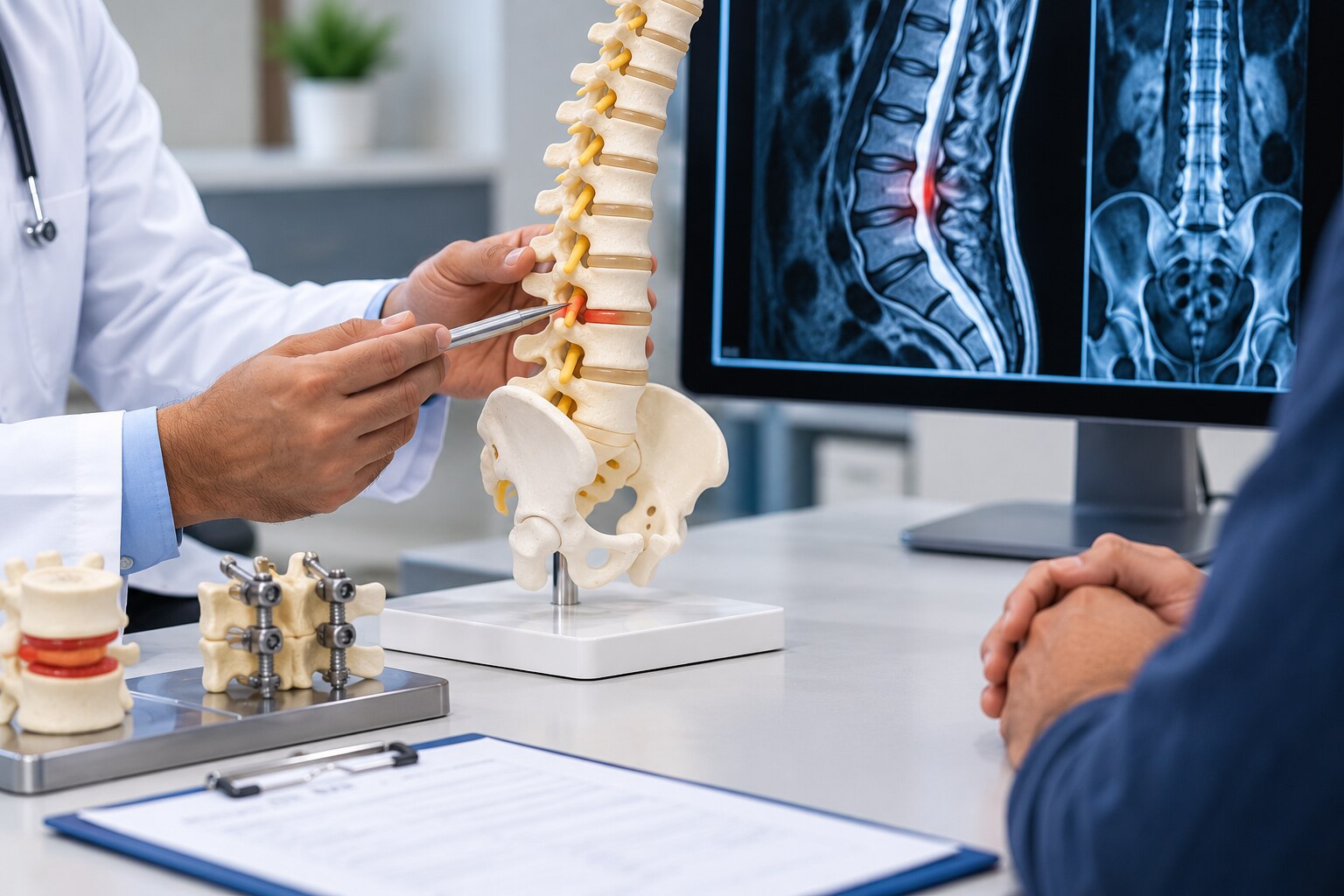
Pain severity alone does not determine the need for surgery. Routine early MRI is not useful for uncomplicated pain because disc bulges and degeneration appear in people without symptoms. Reserve MRI for suspected serious disease, significant or progressive neurological deficits, or situations where the result will change treatment.
What does a structured non-surgical plan involve, and how long should you try it?
A structured plan starts with active care, not bed rest, and is reviewed against progress rather than a fixed deadline. In back pain treatment options in Pune, modify painful lifting, bending, driving or sitting without stopping all movement, and walk within tolerance.
- Use prescribed analgesics when medically appropriate.
- Check NSAIDs against stomach-ulcer or gastrointestinal-bleeding risk, kidney disease, cardiovascular disease, pregnancy and interactions with other medicines.
- Do not rely on paracetamol alone for low-back pain; NICE does not recommend it as sole treatment.
- Change lifting and sitting habits: keep loads close, avoid twisting under load, support your lower back and take regular movement breaks.
- Attend the planned follow-up review, even if pain fluctuates.
Physiotherapy should assess posture and movement before prescribing exercises. A plan may include core and hip strengthening, mobility work, nerve mobilisation when appropriate, graded walking, progressive loading and a written home-exercise programme. This is different from simply being handed exercises.
If pain persists because fear-avoidance, distress or work barriers are limiting recovery, multidisciplinary non surgical spine treatment in Pune may add education, psychological support and return-to-work planning.
| Problem | Review approach | Typical timeframe |
|---|---|---|
| Uncomplicated back pain | Reassess if active care is not improving symptoms | After a short period of consistent treatment |
| Sciatica | Track leg pain, walking and neurological function | Over several weeks |
| Fracture | Follow the specific fracture and healing plan | Condition-specific |
| Neurological symptoms | Earlier clinical reassessment | Do not wait for the routine review |
Worsening weakness overrides any planned waiting period.
When does spine surgery become more reasonable than continued conservative care?
An operation becomes more reasonable when examination and imaging show a surgically correctable problem that matches your disability—not simply because an MRI shows degeneration or your pain score is high.
Urgent assessment and possible surgery apply to:
- Cauda equina compression causing urinary retention or incontinence, bowel-control loss, or saddle numbness.
- Progressive motor weakness from nerve compression.
- Spinal cord compression with worsening weakness, balance problems or hand dysfunction.
- An unstable spinal fracture that threatens alignment or neurological function.
These conditions need prompt evaluation rather than a prolonged trial of exercises or medication.
Elective surgery becomes more reasonable when disabling nerve-root symptoms persist despite structured conservative treatment and the scan matches the examination. For a herniated disc, lumbar discectomy or microdiscectomy removes material pressing on a nerve.
Its main target is radiating leg pain, not isolated nonspecific low-back pain; it also cannot reverse disc degeneration or guarantee permanent relief.
Decompression enlarges space for nerves in lumbar spinal stenosis when neurogenic claudication limits walking or standing and non-surgical care has failed. Fusion adds stabilisation and needs a diagnosis such as demonstrated instability. NICE advises against fusion for nonspecific low-back pain outside a randomised controlled trial and against disc replacement for managing that pain.
Epidural local-anaesthetic-and-steroid injections are selected for acute, severe sciatica, not ordinary back pain or central-stenosis claudication. Medial-branch blocks and radiofrequency denervation address suspected facet pain only after a positive diagnostic block and failed conservative care.
These are not universal substitutes when comparing spine surgery options in Pune or spine surgery or non surgical care in Pune.
How should you compare spine surgery options in Pune with continued care?
Compare the treatment’s target with your actual symptoms, not with the MRI wording. Ask a spine surgeon in Pune:
- What diagnosis is this operation intended to fix?
- Which symptom should improve: radiating leg pain, walking limitation or axial back pain?
- What happens if I continue structured care without surgery?
- How long have I completed supervised exercise, medication and activity-based treatment?
- What are your rates of infection, dural tear, nerve injury, reoperation and readmission?
- How long will recovery take, and what lifting, driving or work restrictions apply?
A lumbar discectomy or microdiscectomy removes disc material pressing on a nerve. It can relieve leg pain faster, but it does not reverse disc degeneration, guarantee permanent relief or reliably treat isolated nonspecific back pain.
| Option | Main target | Key limitation |
|---|---|---|
| Decompression | Nerve compression causing neurogenic claudication or leg symptoms | Can leave localised back pain when compression was not the pain generator |
| Fusion | Demonstrated instability requiring stabilisation | Not justified by an MRI report that only says degeneration |
| Continued care | Mechanical pain, improving sciatica or stenosis without progressive neurological loss | Requires active rehabilitation and review |
A technically successful decompression can leave back pain if nerve compression was not the primary cause. An epidural local-anaesthetic-and-steroid injection is considered for acute, severe sciatica, not ordinary low-back pain or neurogenic claudication from central spinal stenosis.
Radiofrequency denervation requires failed non-surgical care and a positive diagnostic medial-branch block; facet arthritis on MRI alone is insufficient.
What should you check before choosing a spine surgeon or clinic in Pune?
A registered doctor is only the starting point. Before choosing a spine surgeon in Pune, verify the doctor’s registration through the Maharashtra Medical Council and ask where the procedure will be performed.
- Confirm that the hospital has qualified anaesthesia support, appropriate imaging, intensive-care access and emergency backup.
- Ask who will manage complications after discharge and whom you should contact at night.
- Request the diagnosis, the symptom the operation should improve, expected recovery time and the surgeon’s rates of infection, dural tear, nerve injury, reoperation and readmission.
- Bring scan reports, medication details, previous treatment records and a timeline of weakness, walking limitation, bladder symptoms or bowel symptoms.
- Seek a second opinion if fusion is proposed for pain without demonstrated instability, the scan does not match your symptoms, or the expected benefit has not been stated clearly.
Latkar Multi-speciality Clinic can be assessed using the same questions: ask which hospital will host the procedure and what follow-up and emergency arrangements apply, rather than treating a clinic consultation as proof that surgery is needed.
Registration confirms professional status, not surgical necessity or success. Use this comparison when deciding between spine surgery or non surgical care in Pune:
| Option | Choose it when | Check before proceeding |
|---|---|---|
| Urgent assessment | New bladder or bowel loss, saddle numbness, progressive weakness, fever, cancer history or major trauma | Do not wait for a routine appointment |
| Structured non-surgical care | Symptoms are uncomplicated and no progressive neurological loss is present | Agree on exercises, review timing and worsening-warning signs |
| Surgery | A demonstrated, surgically correctable problem matches persistent disability or neurological deterioration | Confirm the target, expected benefit and hospital backup |
Related product
 | Best Spine surgeon in pune Spine Surgery By Dr Rajendra Latkar Non Invasive treatment for backache. Root blocks, Fascet blocks for Neuralgias(Nerve Pains). Physiotherapy & Rehabilitation. View product → |
Frequently asked questions
When should back pain be treated urgently?
Seek urgent medical assessment for new or worsening leg weakness, loss of bladder or bowel control, saddle numbness, inability to walk, fever with severe back pain, or back pain after major trauma.
How long should you try non-surgical spine care?
The timeframe depends on the diagnosis, examination findings and response to treatment. Use a structured plan with scheduled reviews rather than continuing ineffective treatment without reassessment.
When does spine surgery become more reasonable?
Surgery becomes more reasonable when progressive neurological loss, significant nerve compression, spinal instability or persistent disabling symptoms match examination and imaging findings after appropriate conservative care.
How can you compare spine surgery options in Pune?
Compare the diagnosis, purpose of each procedure, expected benefits, risks, recovery time, non-surgical alternatives and the surgeon’s explanation of what happens if you wait.
Keywords